
Agent-ready is a checkout problem, not a content problem
Most "AI readiness" advice for online stores stops at content. Add schema. Write FAQs. Publish an llms.txt. Make your pages readable.
All useful. All about being found. None of it lets an agent buy.
Buying means an agent can check live price and stock, build a cart, apply your discount and shipping rules, pay, and hand the customer a confirmed order. That isn't a content job. It's a contract between two systems. And the past twelve months have shown how hard that contract is to get right.
A year of agentic commerce, briefly
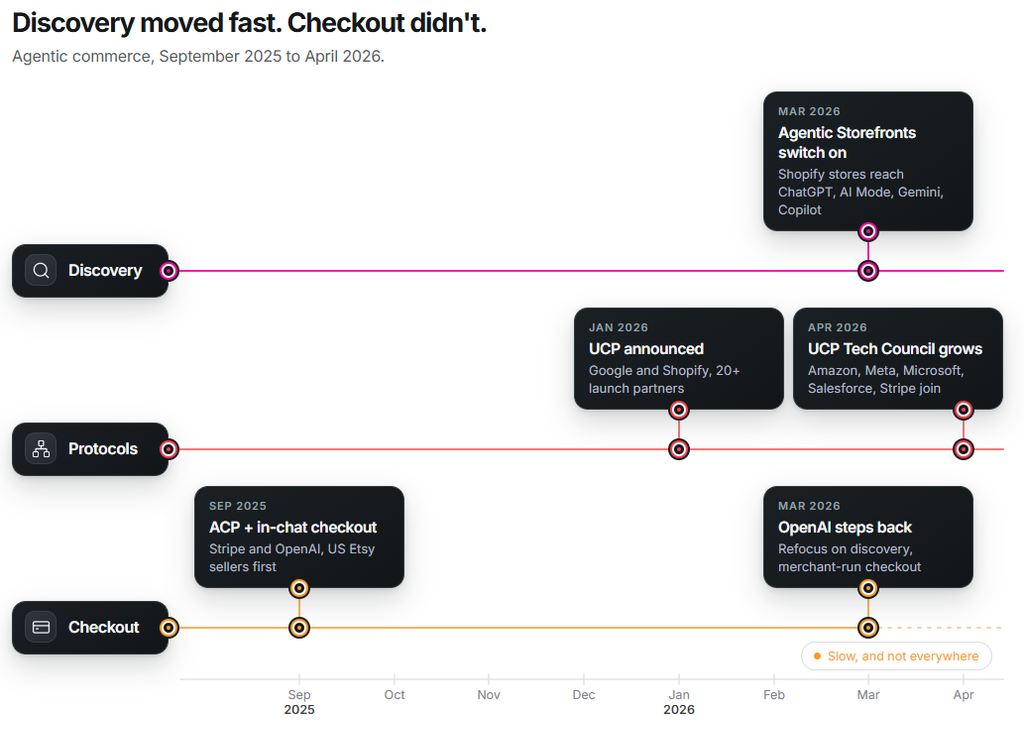
- Sep 2025: Stripe and OpenAI launch the Agentic Commerce Protocol (ACP), alongside in-chat checkout in ChatGPT, starting with US Etsy sellers.
- Jan 2026: Google and Shopify announce the Universal Commerce Protocol (UCP) at NRF, with 20+ launch partners across retail and payments.
- Mar 2026: OpenAI steps back from its first in-chat checkout, refocusing on discovery with merchant-controlled checkout.
- Mar 2026: Shopify begins switching on Agentic Storefronts for all stores, one setup for ChatGPT, Google AI Mode, Gemini and Copilot.
- Apr 2026: Amazon, Meta, Microsoft, Salesforce and Stripe join UCP's Tech Council.
Read that list again and one pattern stands out. Discovery arrived fast. Delegated checkout arrived slowly, and not everywhere.
That's not because the idea failed. It's because real commerce is messy. Discounts stack. Bundles have rules. Subscriptions renew. Some pin codes and postcodes can't be served. A checkout that works for a human clicking through your site has to be re-expressed as something another system can negotiate, without a person there to notice when something looks wrong.
What "agent-ready" actually means
We break it into four layers. Content sits inside the first one only.
One authoritative catalog. Price, stock, variants and attributes that are correct in real time, and identical across your site, feeds and marketplaces. An agent that finds a mismatch has no reason to trust the rest.
Rules as data, not banners. "Free shipping over $75" in a header bar is invisible to a machine. Shipping zones, discount logic, bundle rules and subscription terms need to exist as structured rules your platform can state on request.
A checkout that can be negotiated. This is where the protocols live. The agent asks what's possible, builds the order, and completes payment through an approved handler, all through standard endpoints rather than your front-end.
A clean post-purchase handoff. Order status, delivery tracking and returns that the customer (and increasingly their assistant) can reach without emailing support.
Your platform decides how much of this you build
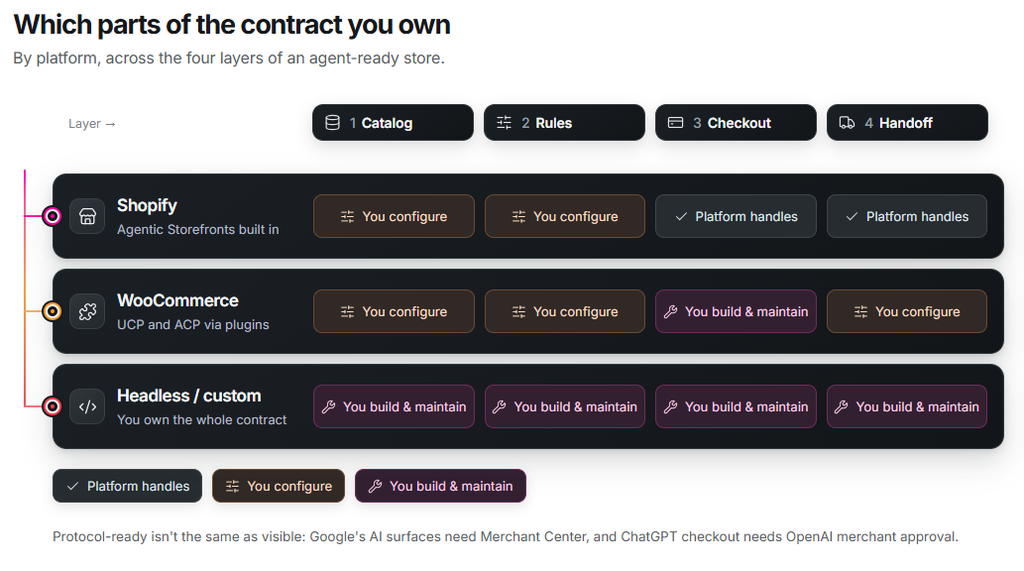
On Shopify, most of layer three is handled for you. Agentic Storefronts abstracts the protocols, so the work shifts to layers one and two: your catalog quality and how your rules are configured. The platform can only expose what you've set up correctly.
On WooCommerce, it's a build decision. Open-source plugins now implement both UCP and ACP, which makes a store technically protocol-ready. But being ready isn't the same as being visible: surfacing in Google's AI surfaces still runs through Merchant Center, and ChatGPT checkout is limited to merchants OpenAI has approved. You'll also own the maintenance as the specs keep moving.
On a headless or custom stack, you own the whole contract. That's more control and more responsibility. It makes sense for brands with complex catalogs and an in-house team, and rarely for anyone else.
None of these is wrong. What's wrong is choosing a platform without asking which parts of the contract you're prepared to own.
What to fix first
We'd sequence it like this for almost any D2C store:
- Catalog truth. Audit every live product for accurate attributes, variants and stock. Make your feed and your site agree.
- Rules as data. Move shipping, discounts and bundle logic out of banners and into platform configuration.
- Measurement. Separate AI-referred traffic and orders in your analytics before you invest further, so you can see what's working.
- Checkout protocols. Only now switch on, install or build the protocol layer. On a clean foundation, it's a small step. On a messy one, it just exposes the mess to more buyers.
The temptation is to start at step four because it sounds like the future. Resist it. An agent that can reach your checkout but can't trust your catalog is a faster way to lose a sale.
Where we come in
Our Commerce Engineering team builds and fixes the layer underneath the storefront (catalog, rules, checkout and handoff) on Shopify, WooCommerce and headless stacks. If you're unsure which parts of the contract you should own, that's the conversation to start with. Book a call →
Sources
- Ken Huang, May 2026: Google and Shopify's UCP and the agentic commerce timeline
- Naturaily, Aug 2026: Agentic commerce for Shopify
- Ask Phill, Apr 2026: Shopify agentic commerce guide
- WordPress.org: UCP/ACP Agent for WooCommerce