
Your product page now has two readers

Every product page you publish is now read twice. Once by a person, deciding whether they want it. Once by a model, deciding whether to recommend it.
This isn't a forecast. On its Q2 2026 earnings call, Shopify said AI-driven traffic and orders to its merchants' stores had each tripled year on year, and that new buyers were arriving through AI channels at nearly twice the rate of other channels. The company described AI as a complement to search, not a replacement for it. So your old reader hasn't gone anywhere. A new one has joined.
The problem is that most D2C product pages were designed for one reader only.
What each reader is looking for
The human reader scans. They want to feel something first (desire, recognition, relief) and then they want reassurance. Will it fit? Will it work for me? What if it doesn't?
The agent reader doesn't feel anything. It is trying to answer a question someone else asked: which dog shampoo is safest for a husky with sensitive skin? Which cold-pressed oil is best for high-heat Indian cooking? It needs facts it can match to that question, stated plainly, in a place it can reach.
Those two needs pull in opposite directions. Write only for the human and the page becomes mood with no facts. Write only for the agent and it becomes a spec sheet nobody wants to buy from.
Where most PDPs fail the second reader
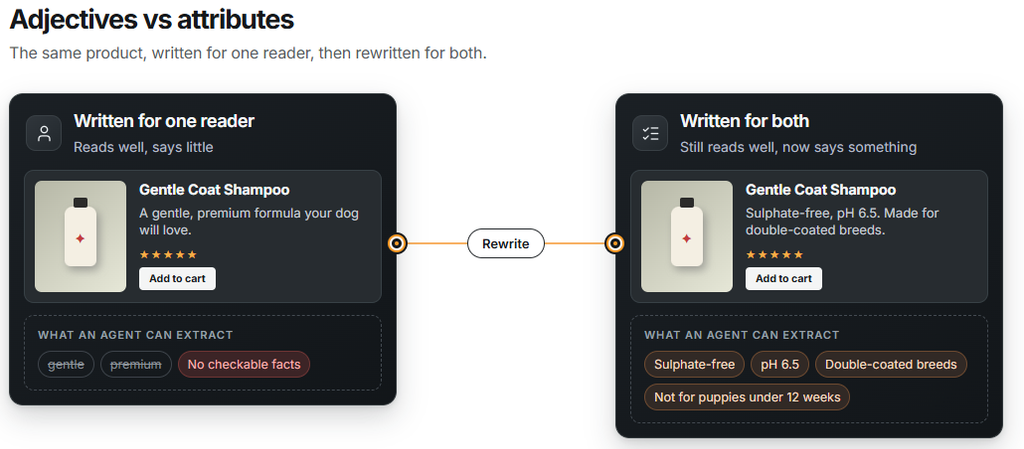
We see the same five gaps in almost every store we audit:
- Benefits locked inside images. The best copy on the page sits in a lifestyle graphic. A person reads it. Most machines don't.
- Adjectives instead of attributes. "Clean", "premium" and "gentle" don't answer anyone's question. "Sulphate-free, pH 6.5, tested on double-coated breeds" does.
- Facts hidden behind interactions. Ingredients in a tab that loads through a third-party app. Sizing in a popup. If it isn't in the page's readable content, assume it doesn't exist.
- Variants named for the brand, not the buyer. "The Classic" and "The Signature" mean something to your team. To an agent comparing options, they mean nothing.
- Policies buried in the footer. Shipping times, returns and stock status are part of the decision. Agents weigh them. Humans do too.
The layered product page
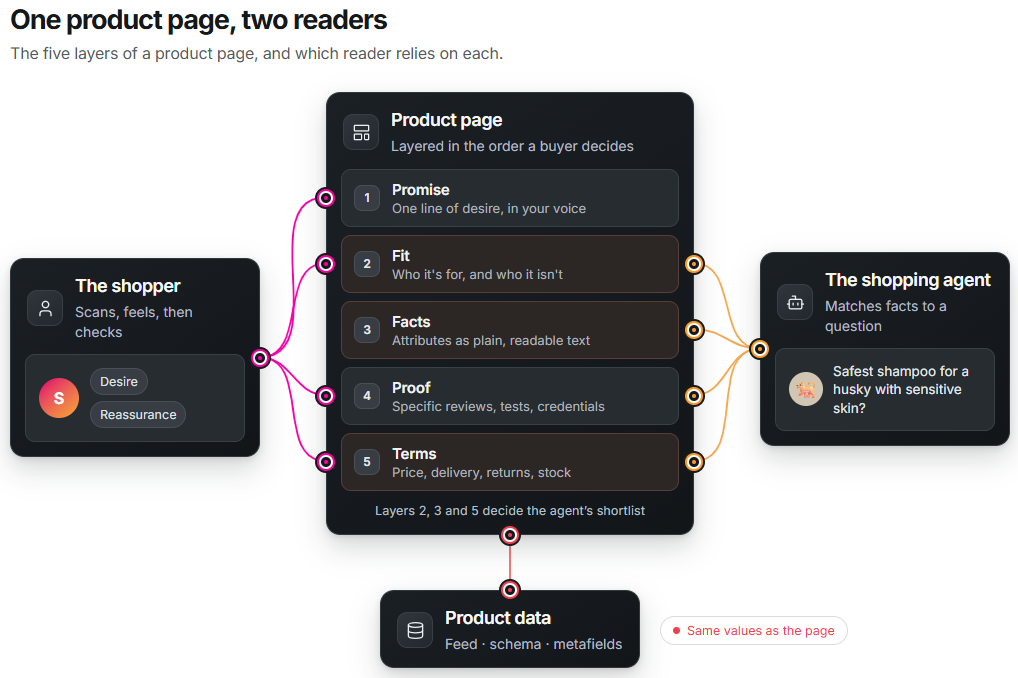
The fix isn't to choose a reader. It's to give each one its own layer, in the order a buyer actually decides.
- The promise. One line of desire, for the human. This is where the brand speaks, and it should sound like no one else.
- The fit. Who it's for, when to use it, and just as important, who it isn't for. Both readers use this layer.
- The facts. Attributes as plain text: materials, ingredients, dimensions, compatibility, certifications. The same values should live in your product data, not just on the page.
- The proof. Reviews that mention specific use cases, not just stars. Test results. Credentials. Anything a third party said.
- The terms. Price, delivery window, returns, stock. Visible, current and consistent with your feeds.
Most pages we see have layers one and four. Layers two, three and five are where the second reader decides whether you're a candidate at all.
Write the "not for" line
This is the single most underused line in D2C copy. Brands avoid it because it feels like turning customers away.
But when someone asks an assistant whether a product is right for them, the assistant needs a reason to say yes or no. A page that says "not recommended for puppies under 12 weeks" gives it one. That line also builds trust with the human reader, who can tell you've thought about them.
The page is only half the job
An agent often forms its view before it ever loads your page. It reads your product feed, your structured data, your listings elsewhere. If your page says 250 ml and your feed says 200 ml, you've introduced doubt at exactly the wrong moment.
Shopify's own numbers point the same way: reporting on its Q2 results noted that searches powered by its structured Catalog converted at roughly twice the rate of those relying on scraped data. Clean product data isn't back-office hygiene any more. It's shelf placement.
So every PDP change needs a matching change in the catalog underneath: metafields, feeds, schema. One source of truth, published everywhere.
A 30-minute test you can run today
- Write down three questions your best customer asked before they bought. Use their words, not yours.
- Ask each one in ChatGPT, Gemini and Perplexity.
- Note whether you appear, what's said about you, and which competitor is named instead.
- Open your own product page and check: could a stranger answer those three questions from the text alone, without clicking anything?
If the answer is no, the gap isn't your ad budget. It's the page.
Where we come in
Our Storefront Audit Sprint reviews your top product pages against both readers, the human and the agent, and hands back a prioritised rebuild plan for your pages and the catalog behind them. Book a call →
Sources
- TechCrunch, Aug 2026: Shopify says AI search is driving more traffic and sales
- Retail TouchPoints, Aug 2026: Shopify credits AI for 34% revenue growth in Q2 2026
- Zacks via Yahoo Finance, Aug 2026: Shopify's AI-driven commerce gains momentum